
The Power of Stories
July 14, 2026 · 7 min read · Mike Mobbs
Subscribe for new posts →At the center of the Indonesian Archipelago sits an island of mountainous peninsulas reaching into the Pacific. It takes its name, Sulawesi, from the Austronesian roots sula (island) and besi (iron), perhaps for the iron-rich Lake Matano in its east. In the hilly south, Karampuang hill rises out of the jungle floor and dominates the skyline. It holds the entrance to Leang Karampuang cave, and on the walls within those dark recesses is what archeologists now believe to be the oldest known example of visual storytelling.
Before the internet or the telegraph, before the printing press, the written alphabet, or the clay tablet, humans relied on storytelling to do two things: define a community's values and carry its knowledge from one generation to the next. Storytelling may be the defining human act. Our stories memorialize who we were, describe who we are, and inspire who we are meant to become.
Though faded across more than 50,000 years, the red pigment shows three human figures around a pig. We can never recover the artist's true intention, or the meaning the images were meant to convey. But we can imagine, and imagination and truth are intertwined. As C.S. Lewis observed:
For me, reason is the natural organ of truth; but imagination is the organ of meaning. Imagination, producing new metaphors or revivifying old, is not the cause of truth, but its condition.
Imagination is the starting point of every story, beginning with the most intimate one: the story we tell ourselves. So, what might this painting have meant to the community that created it?
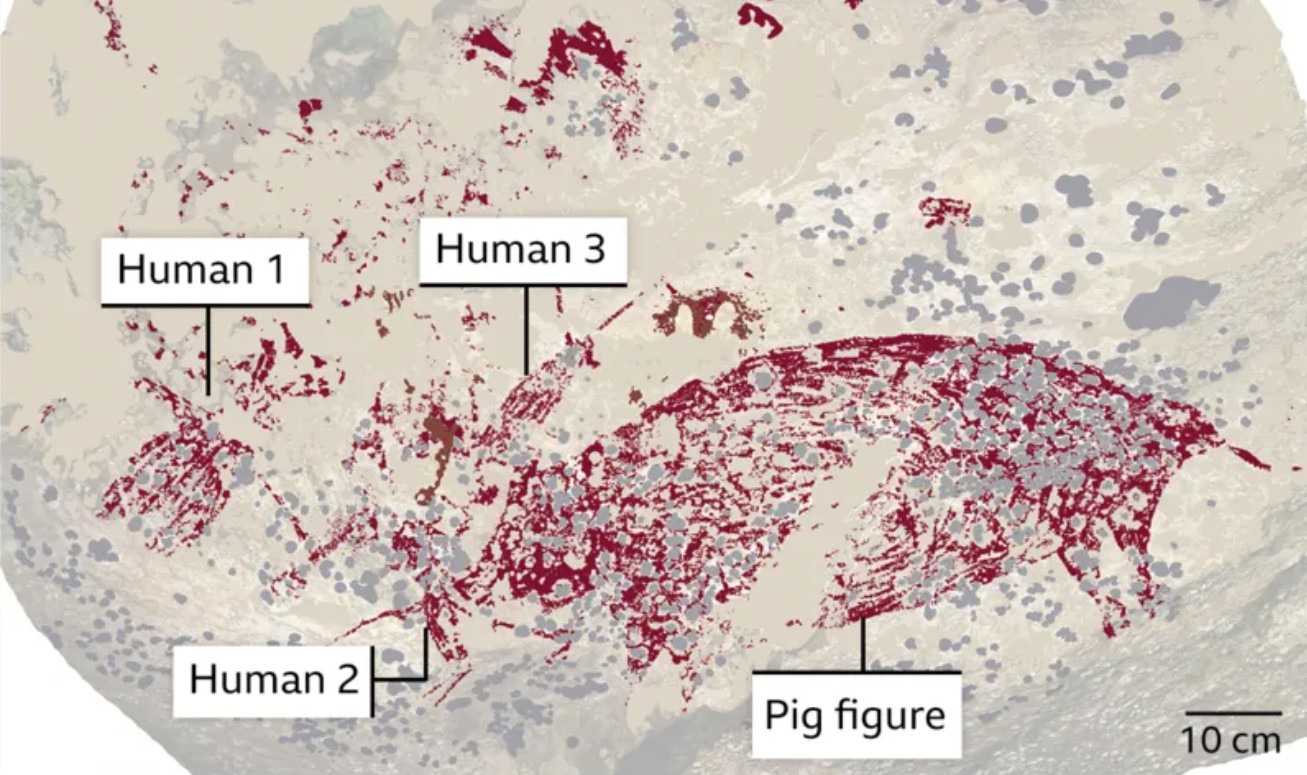
We might imagine it celebrates a successful hunt, honoring those who brought the pig down. With two figures facing the pig and one off to the side, it might instead teach a method of hunting this prey. The background, lost to time, might once have mapped where to find game. But push the imagination further, past the scene itself, and a deeper meaning appears.
A tribute to the hunter would say these people prized sacrifice for the good of the group over the individual. A lesson in technique, or a map to good hunting ground, would say they prized hard-won knowledge and the duty to pass it down, an investment in generations they would never meet; that they believed in a future, in a community that would endure.
For a community, stories carry the values and norms that define a people and steady them against an uncertain world. For a person, they build a sense of self and of place. And no story holds greater sway over anyone than the one they tell themselves.
The stories that we allow to take root in our imaginations are powerful. We live with those narratives playing across our conscious and subconscious, and both the positive and the negative drive our daily actions. These stories do not grant capability beyond your limits. Telling yourself you can run a marathon when you've never run to the end of your driveway is no substitute for training. The more general and subtle the narrative, the more it shapes a person. Consider the following:
- I am brave
- I am worthy of love
- I am good
A person with these narratives engages with the world and experiences life in a very different way from the person with the opposite narratives: I am a coward, I am unworthy, I am bad.
These internal stories have real-world consequences. I remember one selection event early in my military career. My cohort went through a multi-day event with no sleep, near-constant movement, minimal food, and additional stress from the cadre.
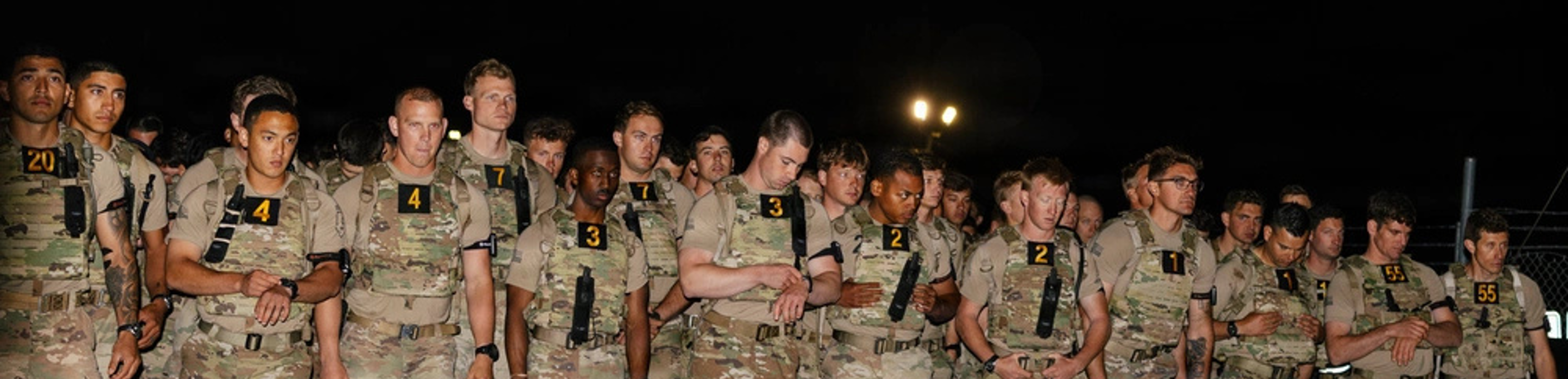
One event found us running in formation, in uniform and boots, on a supposed 5-mile run. Having grown wise to the mind games common to this selection, I had rehearsed the scenarios, including the chance it would continue beyond the expected length. Sure enough, as we approached the turn off the trail back to where we began, the cadre leading the run simply continued on.
As we reached the point we started from, half the formation continued on, following him. But the other half immediately hit an invisible wall and faded to the back.
What explains this? These candidates were all in peak physical condition, well trained, and in the fullness of youth, so why were half able to continue beyond the five-mile mark while the other half could not? The answer was simple. Half the group believed they could make it to the finish line. The other half believed there was no finish line.
This difference was subtle, but crucially so.
In the end, the cadre ran the group only an additional 100 meters before turning back to the starting point, but the mind game had served its purpose: half of these men did not advance in the selection.
Communal stories scale the power of internal narratives beyond the individual. Traditionally, that responsibility fell to the tribal storyteller, the poet, the bard, or the playwright, and also the schoolteacher, the priest, the pastor, and even the parent – especially mothers. For many of us, our first storyteller was our mother, and, in many cultures, women are responsible for passing on morality, ethics, values, history, and language.
In all societies these storytellers are responsible for preserving heritage and history, educating and teaching values, protecting cultural identity and language, and supporting community cohesion and rituals.
Leaders must fulfill these same functions for the teams they lead, and so storytelling is an essential leadership tool.
Stories tell an organization what its shared values are, they provide a common language and a common identity, and they can point an organization toward its future. Stories convey these concepts in a way a memo or presentation cannot, because unlike those modern means of communication stories become ideas embedded in our own imaginations. There, they grow roots, and we breathe a life into them that can extend beyond the story's first telling.
Leaders can do the same to influence their people and change their organization.
Change in any context is challenging, as individuals will typically cling to the status quo if they can. Unless people believe the cost of doing nothing is greater than the cost of change, the status quo will win. But a story can break through this impasse by framing change as part of both organizational and individual identity. That change might take the form of a new direction, a new value, or a new shared culture.
Leaders can achieve something new by channeling something old. They must tell stories about the people and events from the organization's past. These stories can take many formats, but the most effective tell of a hardship overcome, an innovation created, an act of selflessness or even heroism, a collective triumph, or an individual sacrifice for the good of the group. In some cases, they outlast the initial telling to become part of the organization's mythology, a story that transcends realism to embody an essential truth about a people. These stories use the past to create a model that the organization and individuals of today are called to follow.
Stories allow the audience to imagine themselves into those narratives, to see themselves in a new light, and to adopt the traits and values the leader delivers through story. These ideas become sticky, and when a leader calls forward a compelling enough story, a sacred myth, it can move the organization to commit to a shared sense of self. The alternative is to leave the individual in a narrative vacuum that they fill on their own.
The cadre who led our run during the selection event intentionally allowed that vacuum to exist. By leaving it to the individual to fill that empty space, the event revealed who would create an indomitable narrative, and who would not. The cadre’s role was to select individuals, not build a team. Leaders build teams and whether the individual’s story is formed by an external narrative or an internal one is a direct result of leadership.
This is a role that all leaders fill and have filled for much of our history. After all, in ancient communities the storyteller was revered and held in a place of honor. The artist who drew the cave painting in Leang Karampuang had a vital responsibility. By choosing which story adorned the cave walls the artist made a deliberate decision about what mattered to that community, and what narratives would endure to influence anyone who saw it.
Leaders must approach storytelling with the same intentionality. Stories create commitment, and a team that is committed to each other will out-perform a team brought together by compliance.
A team that believes in a shared story will always triumph over a team that believes in nothing.
Leaders create commitment. Leaders instill belief. Leaders tell stories.