
The Line Between Good and Evil
July 28, 2026 · 9 min read · Mike Mobbs
Subscribe for new posts →The line separating good and evil passes not through states, nor between classes, nor between political parties either—but right through every human heart—and through all human hearts. This line shifts. Inside us, it oscillates with the years. And even within hearts overwhelmed by evil, one small bridgehead of good is retained. And even in the best of all hearts, there remains… an unuprooted small corner of evil.
Aleksandr Solzhenitsyn, The Gulag Archipelago
On the afternoon of May 8, 1945, the celebrations in the street were deafening. The New York Times reported that "the financial sector and garment district were thronged from mid-morning on with wildly jubilant celebrators who tooted horns, staged impromptu parades and filled the canyons between the skyscrapers with fluttering scraps of paper." Not to be outdone, the citizens of London, for so long subjected to the terrors of the Blitz, also took to the streets. As reported by the Daily Mail, "processions formed up out of nowhere, disintegrating for no reason, to re-form somewhere else. Waving flags, marching in step, with linked arms or half-embraced, the people strode down the great thoroughfares...."
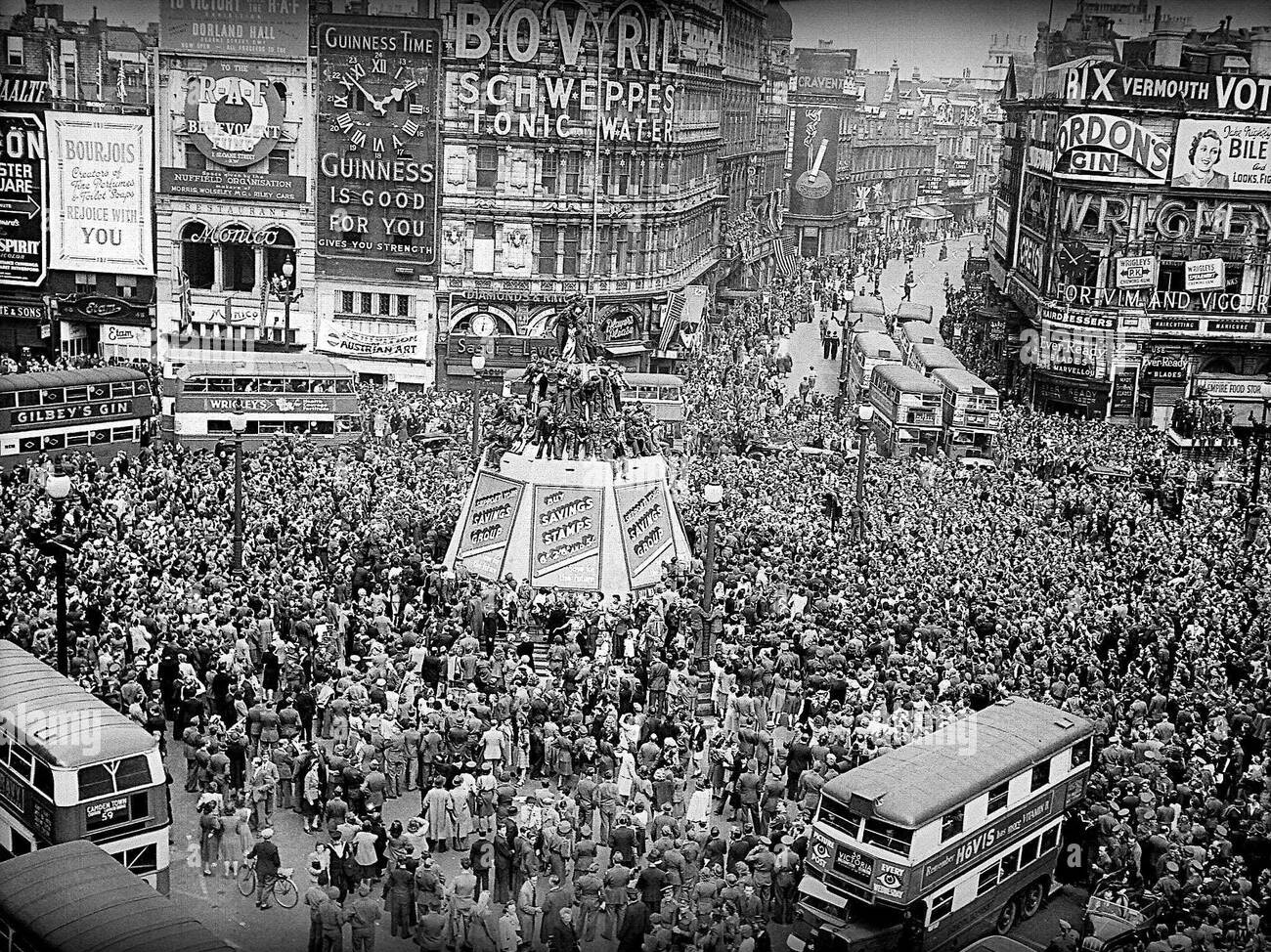
Spanning continents, nations, and communities, the celebrations reveled in joyful victory over Nazi Germany. This marked not just an end to the war, but the triumph of Western civilization. Indeed, the national leaders of the Allied countries framed the war in explicitly existential terms. In his famous "Finest Hour" speech, Winston Churchill declared that "upon this battle depends the survival of Christian civilization. Upon it depends our own British life and the long continuity of our institutions and our Empire." Likewise, Franklin D. Roosevelt called on similar themes in his public remarks.
We are fighting today for security, for progress, and for peace, not only for ourselves but for all men, not only for one generation but for all generations. We are fighting to cleanse the world of ancient evils, ancient ills.
Franklin D. Roosevelt, January 6, 1942
So on that singular May afternoon when throngs of people took to the streets in celebration, part of their joy flowed from the belief that good had triumphed over evil. If Nazi Germany represented all that was ugly and wrong with humanity, then the Allied nations represented all that was noble and good. The sober evidence of numbers easily supported this conclusion.
Over 14 million Allied service members and 39 million civilians, gone.
6 million Jewish victims lost in the Holocaust.
The comforting belief, hard fought and won through strength of arms, seemed undeniable: the moral superiority of the West was not only victorious over evil, but was also impervious to the same.
This belief would not survive close scrutiny.
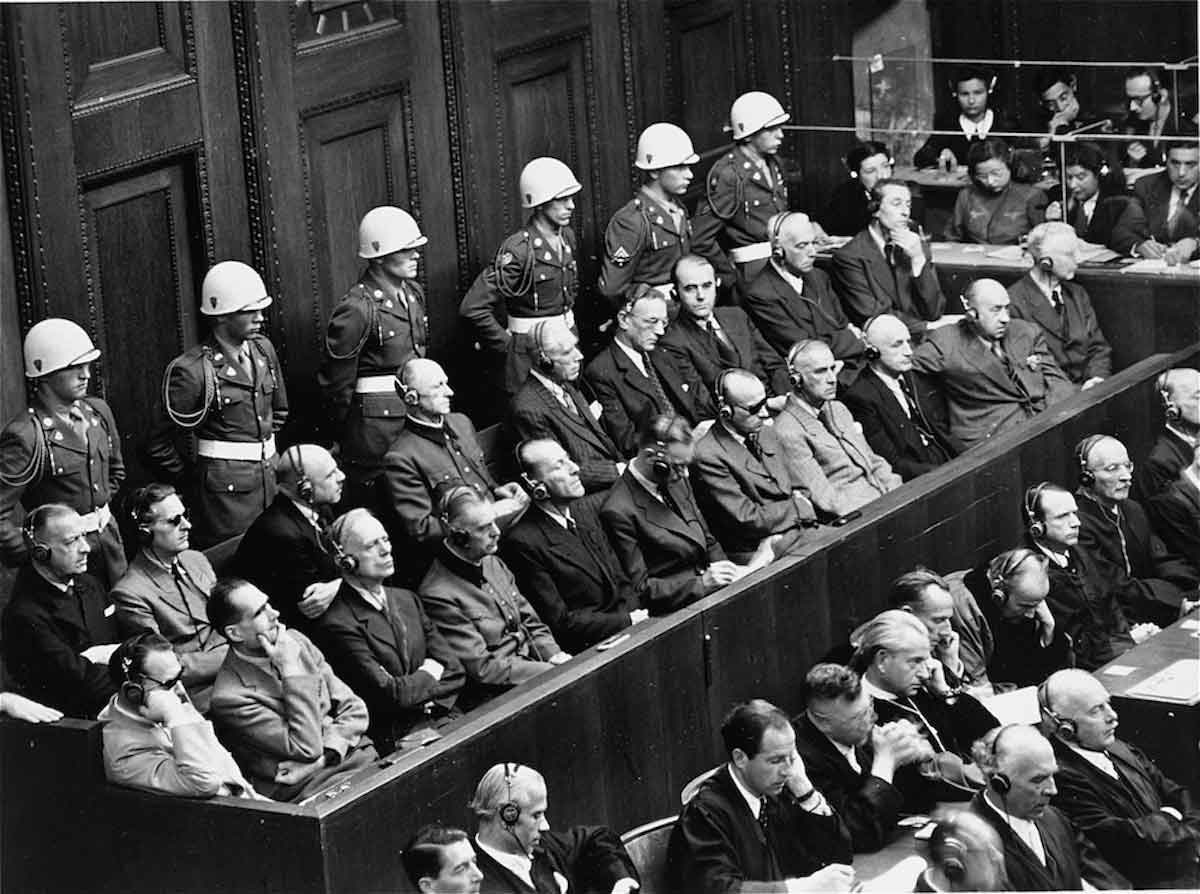
The trial began on November 20, 1945, less than three months after the surrender of Japan, marking the final conclusion to the war. 22 members of the Nazi Party stood trial for crimes committed by their regime. Unprecedented in the course of human history, representatives of a global community sat in judgment over the crimes of another nation that were perpetrated on all mankind. As Rebecca West, a writer for the New Yorker, would note "[the trial] had to deal with new crimes for which there was no provision in national law or international law." The novelty of the process was required to match the magnitude of the crimes, with the soul of the human race at stake. The lead prosecutor, US Supreme Court Justice Robert Jackson, noted in his opening remarks that "civilization cannot tolerate [these crimes] being ignored because it cannot survive their being repeated." Jackson knew that if evil was not confronted it would spread.
What makes this inquest significant is that these prisoners represent sinister influences that will lurk in the world long after their bodies have returned to dust. We will show them to be living symbols of racial hatreds, of terrorism and violence, and of the arrogance and cruelty of power.
Justice Robert Jackson
The inference that Jackson pointed to, and that others were slower to examine, was that the crimes of the Nazis on trial at Nuremberg revealed a shared flaw in all mankind, a flaw that must be held to account lest it be given encouragement and flourish once again.
Jackson's argument was that the evil that lurked within the hearts of the Nazi defendants could find a home within another, and that without justice the same crimes that the Nazi leadership stood accused of committing would once again be revisited upon the world. These crimes were not just crimes against humanity, but also human crimes and so could be repeated by other humans. Rather than turn away from the worst of human nature, Jackson endeavored to meet it straight on.
However, while Jackson's efforts led to the conviction of 19 Nazis, one irony of Nuremberg was that the trials almost had the opposite of the intended effect on public perceptions of evil. The justice obtained by holding these men accountable for their crimes fed the narrative that only Nazi Germany could produce these types of crimes, rather than evidence of the evils that all mankind was capable of.
Academics took up this narrative following the war. Some historians argued that unique structural aspects of German society - weak liberal institutions, authoritarian elites, and a military aristocracy - explained the rise of the Nazi Party. Meanwhile, social scientists pointed to punitive child-rearing, obedience to patriarchal authority, a rigid social hierarchy, and strict military discipline as explanatory factors. The common thread across all disciplines was that the horrors of the Nazi regime were particular to the German social order, and not revelatory of human nature.
This perspective would persist for the next 20 years.
Published in 1963, Behavioral Study of Obedience by Stanley Milgram set off a tidal wave of shock, moral outrage and intense ethical debate. Though well known today, this study was ground-breaking for its time and completely upended the belief that the people of a free and democratic society were impervious to the character traits that made the Nazis' crimes possible.

The experiment consisted of three participants: the "Experimenter" portrayed as an expert scientist, the "Teacher," and the "Learner." The only real test subject in this experiment was the Teacher, while the Experimenter and Learner were roleplaying without the Teacher's knowledge. At the instruction of the Experimenter, the Teacher would administer electric shocks to the Learner for making errors, starting at 15 volts and working sequentially up to 450 volts - a level the Teacher was told might kill the Learner. The Learner would intentionally make errors to give the Teacher the opportunity to send a shock. In reality, no shocks were ever administered, and because the Learner was in a separate room they could roleplay the pain of being shocked while the Teacher listened. If the Teacher hesitated, the Experimenter would encourage obedience. The purpose of the experiment was to test each Teacher's propensity to obey authority, even when prompted to commit evil acts.
Prior to his experiment, Milgram surveyed a cohort of psychiatrists who - in line with popular views of Western resilience - predicted that less than 0.1% of participants would administer the maximum shock levels.
Instead, 65% of participants administered what they thought was a lethal level.
Milgram's experiment revealed that the latent ability to inflict harm, even lethal harm, lived within the average person and that the only thing required to unlock it was the encouragement of an authority figure.
In a sense, Milgram's findings reinforced the guilty verdict handed down at Nuremberg. The leaders of the Nazi party had demanded the obedience of their followers and then used that compliance to visit horrors on their fellow humans and, to the dismay of the Western world, Milgram's experiment also revealed that any one of us was susceptible to that same persuasion.
I set up a simple experiment at Yale University to test how much pain an ordinary citizen would inflict on another person simply because he was ordered to by an experimental scientist.
Stark authority was pitted against the subjects’ strongest moral imperatives against hurting others, and, with the subjects’ ears ringing with the screams of the victims, authority won more often than not.
The extreme willingness of adults to go to almost any lengths on the command of an authority constitutes the chief finding of the study and the fact most urgently demanding explanation.
Stanley Milgram, 1974
That explanation, to the horror of many, was that the evil that lurked within the heart of a Nazi might well live in you or me, and this conclusion would have endured had Milgram just stopped there.
Milgram followed up his initial experiment with 18 different variations, each one changing an aspect of the core experiment:
- moving the Learner into the same room as the Teacher
- moving the Experimenter into a separate room
- the Experimenter "scientist" replaced by a "layperson"
- the experiment itself moved from the Yale campus to a regular office building
In each variation the percentage of Teachers who administered the "lethal" shock level fluctuated, but one variation, Variation 15, had a profound effect.
In this variation, two Experimenters joined the Teacher in the room and gave opposing commands: one ordered the Teacher to continue, while the other ordered the Teacher to stop. The moment that the two authorities disagreed, every participant stopped. 0% continued to 450 volts.
Milgram's methods have not withstood replication and investigative research. Archival work shows the Experimenter improvising pressure far beyond the script Milgram intended, and the 65% figure itself is contested. But that critique only emphasizes the key takeaway: if the results turned on how authority was exercised in that room, then the experiment demonstrated how much leadership matters.
Milgram found more than a dissenting Experimenter stopping Teachers from administering shocks. Milgram revealed two critical insights:
- When authority loses coherence, people will default to their own judgement.
- When people default to their own judgement, people generally choose good.
The great revelation of Milgram's experiment was not that all humans are capable of great evil under the wrong circumstances. Even a casual observer of history knew that to be true. Rather, Milgram forced us to confront this inconvenient truth head-on, as Jackson had called for two decades prior. Any given circumstance can reveal the evil that lives within each of us, but a leader can steer us towards our better angels.
While the crowds of May 1945 celebrated a triumph of good over evil, what Milgram revealed was a victory of good leadership over bad. The capacity for good or evil lives within each of us. But a leader who knows that, who knows that one impossible situation separates any of us from our worst day, can shift that line within us and guide a team through moral ambiguity to bring out its best.
That is the power of a good leader.